jarvis@xinnuomachine.com
Develivery time:30-45 days
Model: 5V PV4
Payment:40% T/T deposit,60% balance before shipping
Voltage:380V 50HZ 3Phase or based on customer’s need.
WhatsApp:+86 188 3070 9860
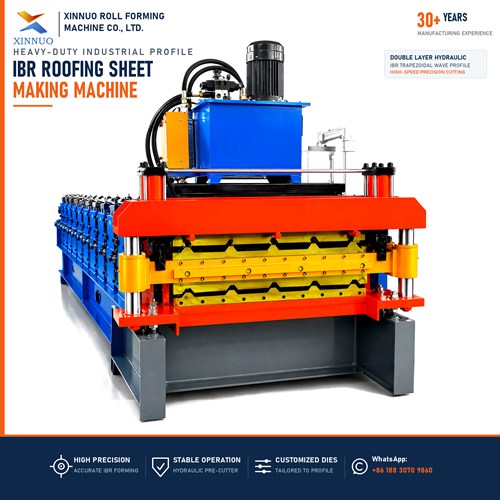
The IBR roofing sheet making machine is a dedicated cold roll forming line for producing Inverted Box Rib roofing sheets from steel coil. Instead of shaping a sheet in a press, the machine bends the strip continuously between rotating roller pairs, so a long sheet leaves the line in one pass with the same section along its whole length. The line is built around the IBR section itself: how many forming stations are used, what each roller pair does to the strip and how the side lap is formed all follow from the rib geometry. That is also why an IBR line cannot simply be re-set to run an unrelated profile.
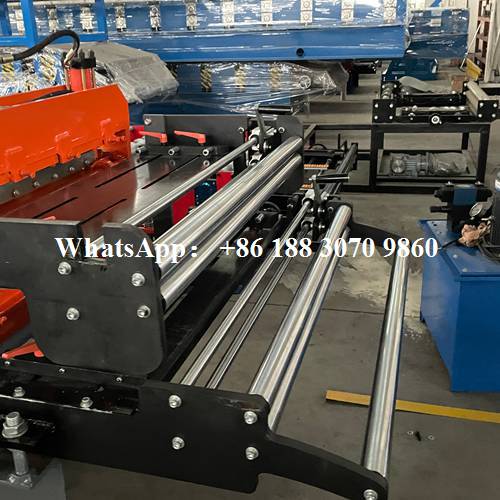
Production begins at the decoiler, where the coil is mounted and the strip is threaded into the entry guide. The strip then passes through the forming stations in sequence, and each station applies one controlled bend, so the flat pan is turned into a box rib step by step rather than in a single operation. The driven rollers also provide the feed force, which keeps the strip under even tension from the first station to the last. After the final pass the profile reaches the cutting unit, is cut to the length entered on the control panel, and is carried away on the run-out table for stacking.
The machine is used wherever IBR roofing sheets are produced in volume: roofing manufacturers supplying building projects, steel merchants holding profile stock, and contractors who need sheets cut to the actual roof length instead of accepting fixed transport lengths. The same line also produces IBR wall cladding, because roof and wall sheeting share the profile and differ mainly in the specified steel gauge and coating.
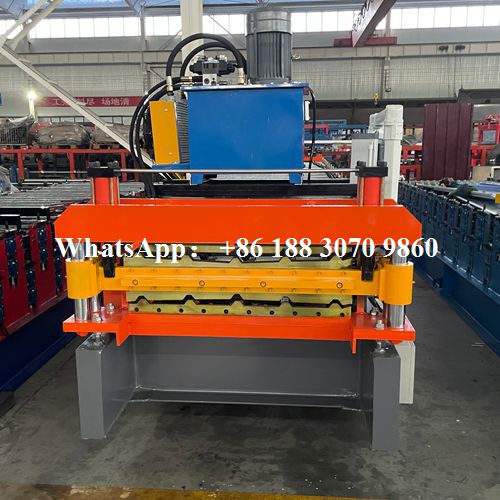
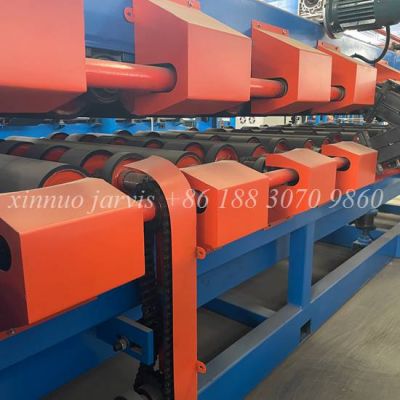
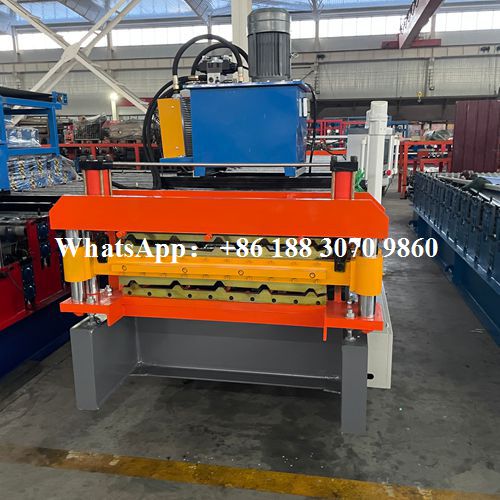
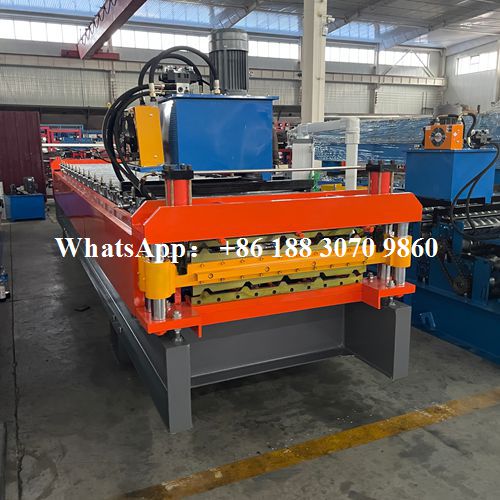
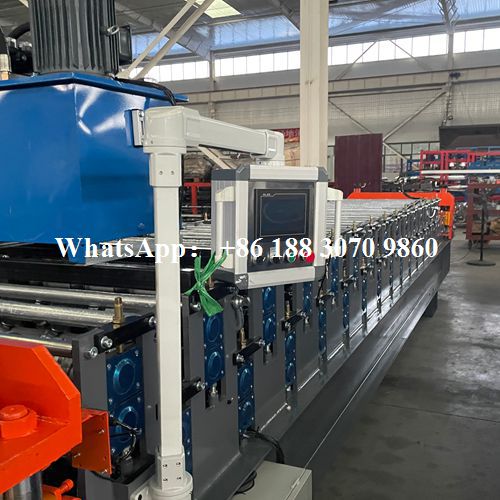
The front view shows the line as one assembly rather than a set of separate machines. Every forming station, the entry guide and the cutting unit are bolted to a single fabricated base, so the strip passes from one pair of rollers to the next without a change in height or centre line. The motor and reducer are mounted at the drive side of the base and connected to the roller shafts through the transmission, which keeps the pulling force inside the frame instead of running it through the sheet. Guard panels enclose the roller train and the drive components, leaving the strip path and the operator controls open.
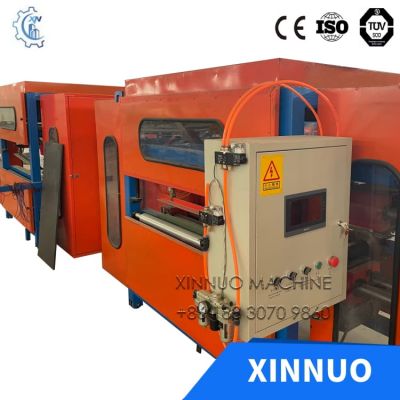
The control panel stands at the operator side of the line, in a position where the strip entry and the forming area stay visible while the machine runs. Running, stopping and speed setting are handled from this point, and the cut length is entered before a production run starts. Access for service was designed into the layout: the guard panels are split into sections above the forming stations, so rollers, shafts and bearing housings can be reached for inspection and adjustment without removing the full enclosure or disturbing the alignment of the stands.
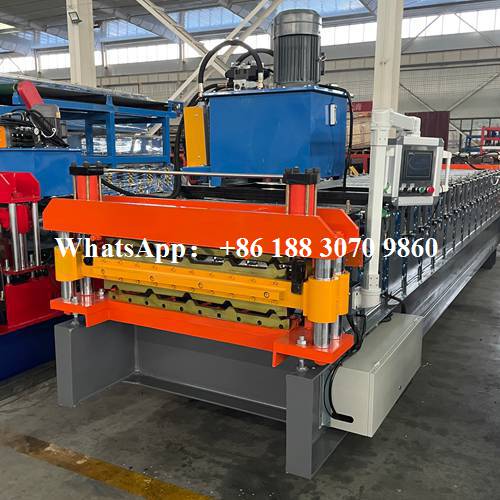
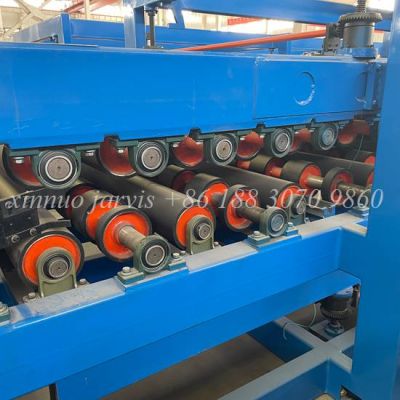
Each forming station carries an upper and a lower roller cut to the intermediate shape that the strip must take at that point in the sequence. The lower roller supports the pan while the upper roller presses the rib down, and the pair together determine both the rib height reached at that station and the amount of material drawn into the rib walls. The pass sequence is fixed by the profile design: a deeper rib or a narrower pan needs more stations, because each one can only take a limited bend without marking or thinning the steel. Roller clearances are set on the bearing housings, so the gap can be matched to the coil thickness actually being run.
Roller condition is the single factor that most affects the appearance of the finished sheet. Contact surfaces are finished to limit scuffing, and the strip is guided so that a coated face does not rub against a sharp edge on its way through the line. Roller material and surface treatment are specified according to the coil type and the customer's requirement, since a line running thin galvanised sheet is not built to the same specification as one forming thicker pre-painted material. When a roller does wear, it is replaced individually and the affected pass is checked against the finished rib, rather than replacing a complete station.
The values below are confirmed against the approved profile drawing and the coil specification supplied by the buyer. Entries marked for confirmation are agreed before the order is released, and a layout drawing is issued for approval before shipment; no working figure is treated as fixed until it has been checked against the actual section and material.
| Working material | Pre-painted steel coil, galvanised steel coil |
| Coil thickness | According to customer requirement and profile design |
| Profile | IBR (Inverted Box Rib), per customer drawing or sample sheet |
| Number of forming stations | Fixed by the profile design after drawing review |
| Roller and shaft arrangement | Confirmed with the working width of the line |
| Drive | Motor and reducer matched to the line load; confirmed at order stage |
| Cutting | Cut-to-length after forming; cutting method confirmed with the order |
| Control | Configuration agreed at order stage |
| Power supply | Matched to the installation site; voltage and frequency to be confirmed |
| Line layout | Drawing issued for approval before shipment |
| Country of origin | China |
Provide the profile drawing, the coil thickness range and the required sheet length, and the table is returned with fixed values for quotation.
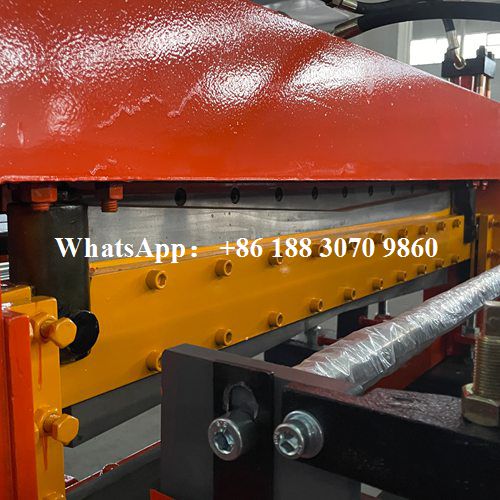
Each forming station is built on a pair of shafts supported in bearing housings at both ends of the stand. The shafts are machined from solid bar, and the rollers are located on them by keys, so torque is transmitted positively and no roller can rotate on its shaft during a forming pass. Shaft diameter and material follow the working width of the line and the load expected from the coil thickness range, because a narrow line forming light gauge and a wide line forming heavier material place very different demands on the same component. The housings are adjustable so that roll gap and shaft parallelism can be set at commissioning and re-checked after transport.
The motor and reducer sit on a common base at the drive side, and power reaches the roller shafts through the transmission selected for the line configuration. Because the stations are driven in step, every roller pair turns at the same surface speed, which is what keeps the strip from being pushed in one section and pulled in another. Bearings are grease-lubricated and reached from the drive side; a fixed lubrication routine, together with a check of shaft alignment after the machine is anchored and levelled on site, are the two maintenance points that most directly govern rib consistency and shaft life.
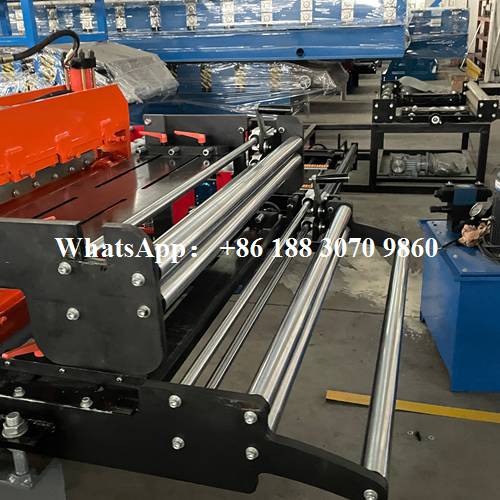
The output is an Inverted Box Rib sheet: box-shaped ribs pressed inward between flat pans, with a formed side lap at each edge so that adjacent sheets nest together and fix through a single line of fasteners. This section gives the sheet its spanning strength, which is why a comparatively light gauge can cover a wide area of roof. Cover width, rib height and rib pitch follow the approved drawing, so the sheets run on this line can be combined with the trims, flashings and fasteners already specified for the project.
Sheet quality is judged on three visible points: the coating must stay intact on the exposed face, the rib line must remain straight over the full sheet length, and the cut ends must be square so sheets meet cleanly at ridge and eaves. All three are governed inside the machine, by roller finish, roll gap setting and strip guidance, rather than by anything done to the sheet afterwards. Sheets are stacked and banded as they leave the run-out, supported along their length so the bundle does not sag and the coated face is not marked in transit.
HEBEI XINNUO ROLL FORMING MACHINE CO., LTD has been designing and manufacturing cold roll forming equipment for more than 30 years, and machines built in our works are running in over 110 countries and regions. The range covers roof and wall panel forming lines, IBR and trapezoidal sheeting machines, double layer machines, glazed tile machines, C and Z purlin lines, gutter and curving machines and other steel processing equipment, together with the decoilers, cutting units and run-out tables that complete a production line.
Machines are built to order rather than from a fixed catalogue. We start from the customer's product section drawing, the raw material and thickness range, the required output and the level of automation asked for, then design the station sequence, shaft arrangement and drive around those inputs. Drawings are submitted for approval before manufacture, and the electrical configuration is matched to the supply available where the line will be installed. Technical advice before the order, installation and commissioning guidance, operator documentation and after-sales support for wear parts are all part of the supply, so the buyer keeps a single technical contact from profile review through to production start-up.
Output depends on the line speed achievable with the confirmed profile and coil thickness, and on the sheet length being cut, because every cut interrupts the run. Both are settled once the profile drawing and coil specification are known; we do not quote a capacity figure before that point, since a number taken from a different profile would not apply.
Yes. IBR roof and wall sheeting share the same section, so the same roller set forms both. The difference lies in the gauge and coating specified for each application, and in the sheet lengths required, both of which are set at the cutting and control stage rather than by changing rollers.
The required coil width follows from the developed width of the IBR section, which is calculated from the profile drawing including the side lap. Once the drawing is confirmed we state the coil width and thickness range that the line is designed for, so the buyer can order coil against a known figure instead of an estimate.
The first sheet off the line is measured against the approved drawing: rib height, rib pitch and cover width are checked, together with the side lap fit on a paired sheet. Roll gaps are then trimmed on the bearing housings if required. This first-off check is repeated after any roller change, so the section is confirmed by measurement rather than by eye.
Decoilers, run-out tables and stacking arrangements are specified together with the line, and the scope included in a given quotation is listed item by item, so it is clear which operations are powered and which are carried out manually. Where a buyer intends to add equipment later, this is allowed for in the layout at the design stage.
The machine is delivered with a spare parts list covering forming rollers, shafts, keys, bearings and cutting blades, and these items can be ordered individually afterwards. Because they are wear parts, the list is issued with the machine so that stock can be planned before production begins rather than after a stoppage.
Xinnuo Machinery Co., Ltd., established in 1995, is a subsidiary of Hebei Xinnuo Roll Forming Machine Co., Ltd., previously known as Botou Huayu Roll Forming Machine Factory. We focus on the design, manufacturing, and sales of cold-formed machinery, offering a broad range of high-performance equipment.
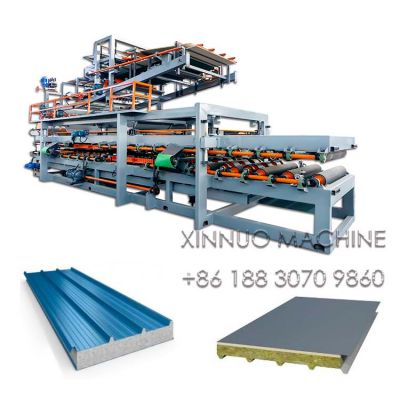
Our star product, the sandwich panel production line, is one of our most popular machines and has been exported to countries across the globe. Renowned for its high efficiency and versatility, this machine is key in the production of insulated panels used in various industries. Our commitment to innovation is reflected in the over ten patents we hold, and our recognition as a National High-Tech Enterprise further solidifies our reputation as an industry leader.
[ read more ]